
It’s 3:00 AM on a Sunday. BTC drops 8% in ten minutes. You go to adjust your hedge, but your centralized exchange has "scheduled maintenance," and your bank has flagged your last wire as suspicious. In the legacy world, risk management is a permissioned privilege; in the crypto-native world, it is a mathematical certainty.
Traditional stop-losses mean nothing if a legacy broker’s internal B-Book desk "hunts" your liquidity during a flash crash. This guide moves beyond the illusion of safety provided by black-box platforms. We are shifting the focus from trusting a counterparty's solvency to verifying on-chain settlement and utilizing non-custodial deposits.
By the end of this article, you will know how to calculate the Math of Ruin for 24/7 volatility, audit price signatures, and use permissionless cross-asset hedging to protect your stack—without ever off-ramping to fiat.
What You'll Learn
- The Math of Ruin in 24/7 Permissionless Markets
- Non-Custodial Deposits: Security at the Source
- Eliminating 'B-Book' Risk with Verifiable Execution
- Permissionless Cross-Asset Hedging Strategies
- The '60-Second' Risk and Progressive Decentralization
- Frequently Asked Questions
The Math of Ruin in 24/7 Permissionless Markets
Risk management in crypto-native trading requires a different calculus than legacy equity or forex markets. The traditional "weekend gap" is replaced by the "liquidity flash-crash"—a sudden, violent wick that triggers cascading liquidations across fragmented order books.
Calculating Position Sizing for Liquidity Flash-Crashes
Professional traders use the Kelly Criterion to size positions based on their historical win rate and risk/reward ratio. However, when trading on a decentralized forex broker, you must adjust this formula for the correlation between your collateral and the broader market. If you are funding a short EUR/USD position using BTC as collateral, a sudden drop in Bitcoin's price reduces your available margin exactly when market volatility spikes.
Example: You enter EUR/USD at 1.0850 with 30:1 leverage using $1,000 in BTC collateral. That is a $30,000 notional position. If EUR/USD moves 50 pips against you (a $150 loss), but BTC simultaneously drops 10% in a flash crash, your effective collateral is now only $900. Your margin utilization has spiked from two vectors at once.
The Volatility Tax: Why Traditional Drawdown Limits Fail
To survive 24/7 markets, operators must define their "Uncle Point"—the specific drawdown level where the strategy mathematically breaks, regardless of conviction. If your portfolio suffers a 50% drawdown, you need a 100% gain just to break even. This volatility tax destroys undisciplined traders.
Instead of static percentage stops, crypto-native traders size positions based on average true range (ATR) and verifiable volatility metrics, ensuring that a single 3:00 AM liquidity void does not force an unwanted liquidation.
Non-Custodial Deposits: Security at the Source
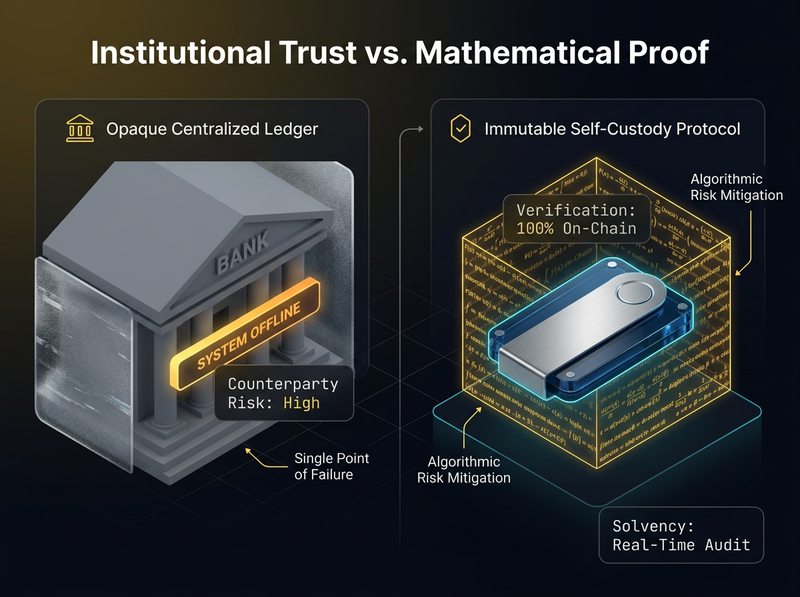
In the legacy system, depositing funds means issuing an unsecured loan to a centralized entity. If the platform fails, you become an unsecured creditor trapped in years of bankruptcy litigation. Forexiz fundamentally alters this dynamic through architecture, not promises.
Minimizing Counterparty Exposure via Cold Storage
Risk management begins with self-custody. You should keep the vast majority of your capital in hardware wallets, moving assets to Forexiz non-custodial deposits only when active margin is required. Because the platform is permissionless, there are no multi-day KYC approval queues to clear before you can fund an account to defend a position.
Pro Tip: When evaluating a permissionless venue, the first thing to verify is that withdrawals execute on-chain to the address you control—if the platform routes withdrawals through their corporate wallet, "non-custodial" is marketing, not architecture.
Just-In-Time (JIT) Funding Mechanics
USDT funding allows for permissionless forex access in roughly 60 seconds. You can deposit 500 USDT via TRC20 (with a network fee of ~$1), and the funds are available for trading immediately after on-chain confirmation.
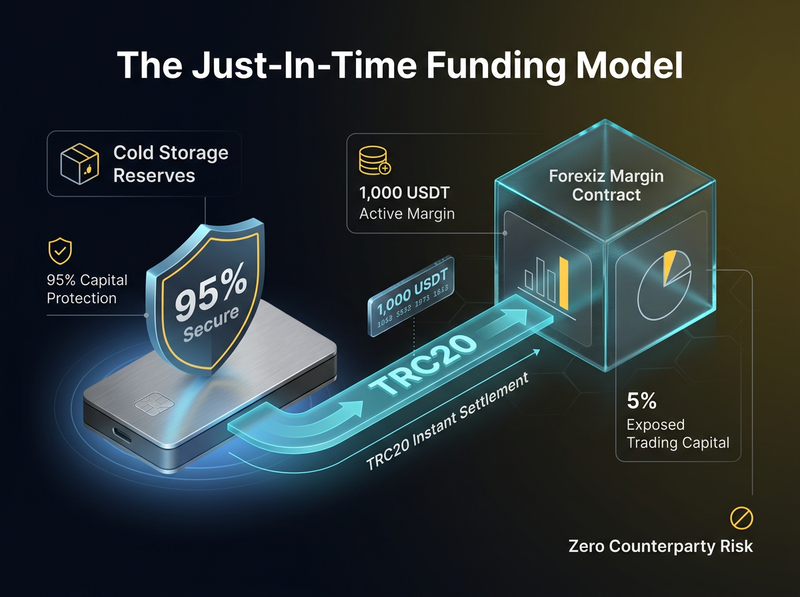
Verify: Forexiz publishes deposit contract addresses on-chain. Check the source code at the linked block-explorer page before depositing anything. You can independently audit your non-custodial deposits to ensure your collateral has not been rehypothecated to a third-party hedge fund.
Eliminating 'B-Book' Risk with Verifiable Execution
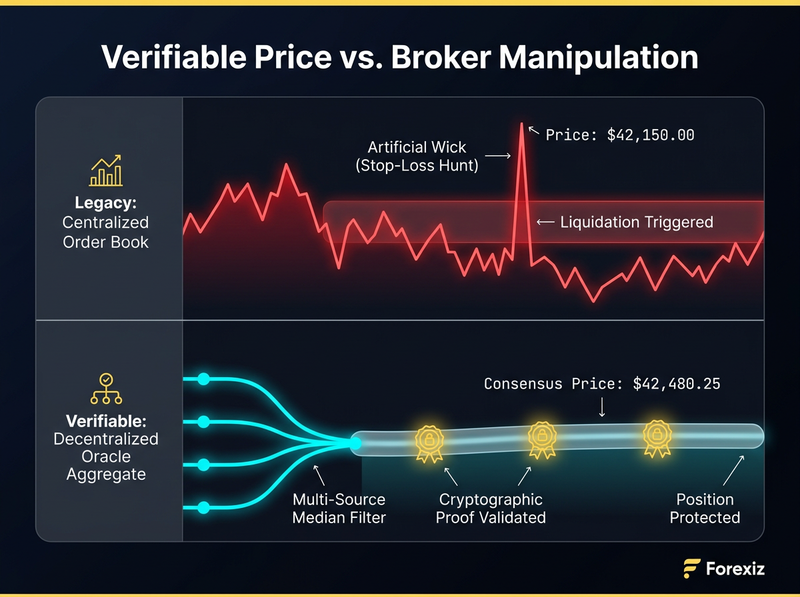
One of the most insidious risks in legacy forex is the internal "B-Book." Centralized brokers often take the other side of retail trades. When a market drops, it is highly profitable for them to widen spreads artificially, triggering a cascade of stop-losses before returning the price to the market baseline.
Signed Price Feeds vs. Internal Desk Manipulation
Stop-loss hunting is a feature, not a bug, of centralized systems. Forexiz solves this through verifiable execution. Instead of an opaque internal feed, prices are aggregated from decentralized oracles and cryptographically signed.
Example: A signed price quote uses Ed25519 over a Pyth-feed root; you can verify it client-side in ~2ms. If your stop-loss is triggered, it is because the mathematical aggregate of global liquidity reached that price, not because a desk manager needed to balance their books.
Auditing Your Stop-Loss via On-Chain Commitments
We operate on a "Don't Trust, Verify" workflow. Every critical action relies on on-chain trust and cryptographic commitments.
Verify: The Forexiz price oracle's public key is published transparently. You can match every quote you receive against it; if the signature doesn't verify, the trade cannot execute. You never have to wonder if a sudden wick was real—you can audit the exact timestamp and signature that triggered your settlement.
Permissionless Cross-Asset Hedging Strategies
Systemic risk in crypto cannot always be hedged with other cryptocurrencies. When the entire market correlates to 1 during a macro panic, pure DeFi platforms offer little protection. Forexiz bridges this gap by allowing you to trade traditional assets while remaining crypto-native.
The XAU/BTC Inverse Correlation Play
During high-volatility cycles, traders often look to gold as a safe haven. Instead of selling your Bitcoin spot holdings—triggering taxable events and losing your position—you can use your crypto collateral to access XAU/USD.
Example: A swing trader holds 2 BTC in cold storage. Fearing a macro downturn, they allocate 2,000 USDT to Forexiz non-custodial deposits and take a long position on Gold with 20:1 leverage. If crypto markets tank due to inflation fears, the Gold position acts as a verifiable hedge against the drawdown.
Hedging Systemic Risk Without Fiat Off-Ramps
In legacy finance, hedging often requires moving back to fiat, exposing you to bank freezes and multi-day settlement delays. By trading forex pairs, metals, or indices directly from your crypto wallet, you maintain a delta-neutral stance without relying on the banking system. You calculate the cost of the hedge (spreads and overnight funding) and weigh it against the mathematical cost of suffering a 20% portfolio drawdown.
The '60-Second' Risk and Progressive Decentralization
Frictionless entry is a double-edged sword. When you can fund an account and enter a trade in under a minute, the psychological barrier to "revenge trading" disappears.
Automating Parameters to Counter Frictionless Entry
Because access is permissionless, the discipline must come from the operator. Speed of execution requires pre-set, automated risk parameters. You must calculate your maximum daily loss and enforce it mathematically. If a trade goes against you, the system will execute your stop-loss precisely based on the oracle's signed price—there is no broker to call, and no manual override to save a blown margin account.
On-Chain Settlement as the Ultimate Circuit Breaker
Legacy brokers frequently freeze funds during extreme market events, citing "liquidity provider issues" or "compliance checks." According to public data, including reports from the Bank for International Settlements (BIS) on FX settlement risk, reliance on centralized intermediaries creates massive counterparty bottlenecks.
Forexiz relies on progressive decentralization. While trading execution is optimized for speed off-chain, settlement relies on on-chain mechanics. This ensures that even in extreme volatility, your exit remains mathematically guaranteed by the smart contract queue, not by human intervention.
Conclusion
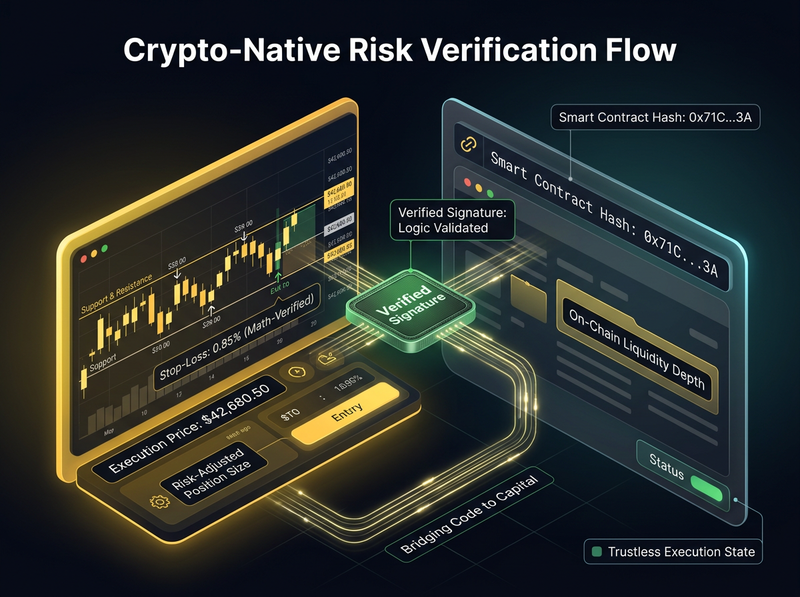
Risk management is evolving from a set of "best practices" into a verifiable architecture. You no longer need to hope a legacy broker stays solvent or that a traditional bank approves your withdrawal during a market rout. By utilizing non-custodial deposits and verifiable execution, you regain sovereignty over your capital.
This week, audit your current counterparty exposure: how much of your stack is sitting in an opaque, centralized black box? Move toward a workflow where you only commit what is necessary for the trade, and verify every price signature on-chain.
Don't trust the broker's dashboard. Head to /trust/verify to audit the latest signed price feeds and see how on-chain commitments protect your next trade from manipulation. Verify the math.
Frequently Asked Questions
What is the math of ruin in crypto-native trading?
The math of ruin refers to the mathematical certainty that recovering from deep drawdowns requires exponentially higher returns (e.g., a 50% loss requires a 100% gain). In crypto-native trading, this is exacerbated by 24/7 volatility, requiring precise position sizing and strict "Uncle Point" drawdown limits.
How do non-custodial deposits work on Forexiz?
Non-custodial deposits allow you to route funds from your self-custodied wallet into a smart contract specifically for margin trading. You retain cryptographic control over your deposits and withdrawals, ensuring your capital is not rehypothecated or used as an unsecured loan by the platform.
How do I verify my stop-loss execution on-chain?
Forexiz uses cryptographically signed price feeds (such as Ed25519 signatures via Pyth). You can audit the exact timestamp and public key signature of the price that triggered your stop-loss, proving it was executed based on global market aggregates rather than internal broker manipulation.
What is progressive decentralization in forex?
Progressive decentralization is the spectrum of moving platform mechanics from centralized control to on-chain, verifiable architecture. For Forexiz, this means starting with permissionless access, non-custodial deposits, and verifiable on-chain settlement, while maintaining high-speed execution layers that systematically decentralize over time.