The ghost of FTX still haunts the crypto-native trader. In the wake of centralized failures, the demand for truly permissionless access and verifiable execution has skyrocketed, pushing many towards the allure of 'tokenized stocks.' Imagine trading global equities 24/7, funded directly from your self-custody wallet, bypassing archaic KYC and banking restrictions. It sounds like the crypto-native dream. Yet, beneath the surface, many of these new tokenized offerings carry significant centralized counterparty and opaque oracle risks, often replicating the very trust assumptions we're trying to escape. This article will equip you to cut through the noise, understand the critical distinctions, and identify where true verifiable trading lies, empowering you to make informed decisions and verify the math yourself.
What You'll Learn
- Unlocking Global Markets: The Allure of Tokenized Stocks
- Beyond the Hype: Verifying Price Feeds & On-Chain Truth
- Securing Your Capital: Non-Custodial Deposits & Progressive Decentralization
- Optimizing Your Edge: Crypto-Native Trading Mechanics & Capital Efficiency
- Expanding Your Horizon: Permissionless Access to a Verifiable Market
- Frequently Asked Questions
Unlocking Global Markets: The Allure of Tokenized Stocks
For the crypto-native trader, the traditional financial system is a maze of arbitrary restrictions. Trading US stocks from Southeast Asia, accessing forex markets without multi-day bank wires, or shorting an index over the weekend are often impossible. Tokenized stocks emerge as a compelling solution to these problems, promising to port the world's assets onto crypto rails.
Defining Tokenized Stocks: Synthetic, Crypto-Funded Derivatives
At their core, tokenized stocks are synthetic derivatives. They are tokens on a blockchain whose value is designed to track a real-world asset, like a share of AAPL or a barrel of WTI crude oil. An issuer—a centralized company—typically buys the underlying asset and then mints a corresponding token. This allows for fractional ownership (you can buy 0.1 AAPL) and 24/7 trading, all funded with stablecoins from your self-custody wallet.
The Crypto-Native Appeal: Bypassing Traditional Barriers
The appeal is immediate and powerful. Tokenized stocks offer:
- Permissionless Access: Bypass geographical restrictions, lengthy KYC procedures, and the need for a traditional brokerage account.
- Crypto-Capital Integration: Deploy your USDT, USDC, or other crypto assets directly into global markets without off-ramping through a bank.
- 24/7 Markets: Trade equities and commodities on weekends and holidays, just like crypto.
- Composability: The potential to integrate these assets into other decentralized financial applications.
They represent a step towards a unified, global market. However, the architecture behind this promise determines whether you're gaining freedom or just swapping one set of gatekeepers for another.
Beyond the Hype: Verifying Price Feeds & On-Chain Truth
A synthetic asset is only as good as its price feed. If the price you trade doesn't reflect the real-world asset's value, you're not trading that asset—you're gambling on an operator's black box. This is where the critical difference between a tokenized promise and a verifiable instrument emerges.
The Oracle Dilemma: Centralized Feeds and Trust Assumptions
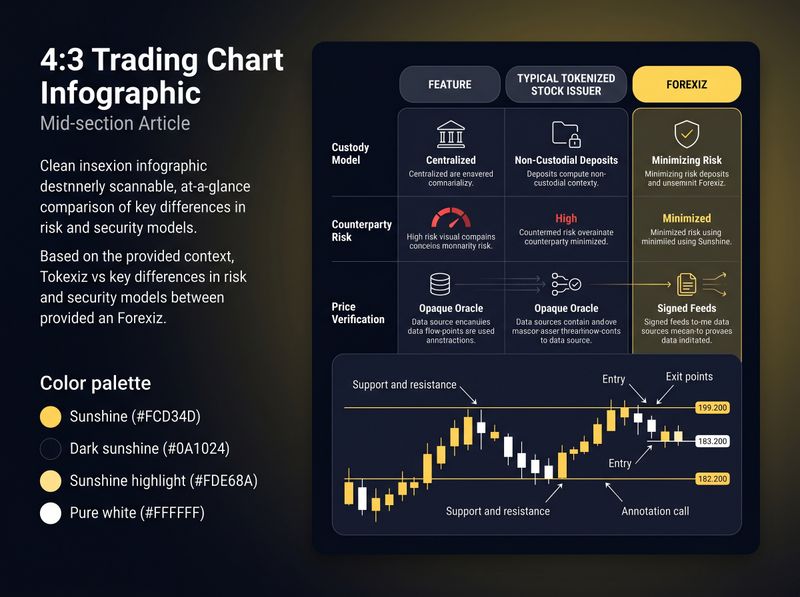
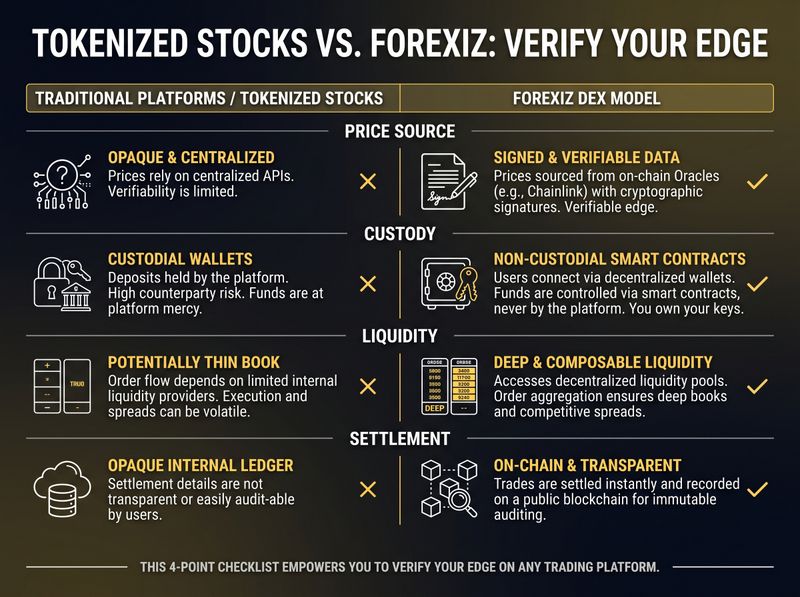
Most tokenized stock platforms rely on oracles to get their price data. Often, this is a centralized feed from a single data provider or, worse, from the issuer itself. This creates significant trust assumptions:
- Single Point of Failure: If the oracle's API goes down or provides faulty data, trading can halt, or liquidations can occur at incorrect prices.
- Manipulation Vector: A malicious or compromised issuer could manipulate the price feed to their advantage, triggering stop losses or creating artificial slippage.
- Lack of Transparency: The price is simply a number delivered to you. You have no way to cryptographically verify its origin or integrity before you execute a trade.
Forexiz's Verifiable Edge: Signed Prices and On-Chain Settlement Commitments
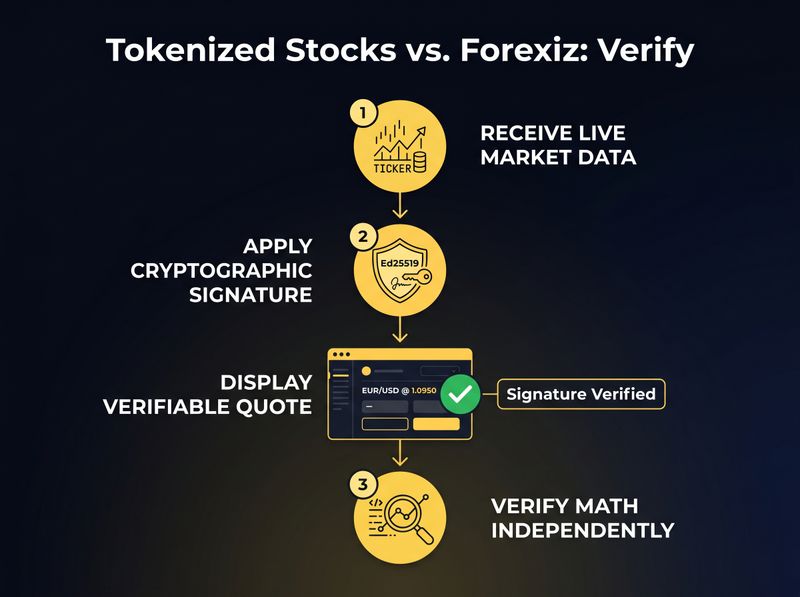
Forexiz takes a fundamentally different approach. We operate on the principle: "Don't trust us. Verify the math." For every one of our 68+ instruments, the price you see is not just a number; it's a cryptographically signed message.
Each price quote is signed using the Ed25519 signature scheme, a high-speed, high-security standard. This means you can verify, client-side, that the price quote originated from our oracle and hasn't been tampered with in transit. This creates a verifiable, auditable trail for every tick of data.
Verify: Forexiz's price oracle public key is published at /trust/verify. You can match every quote you receive against it. If the signature doesn't match, the price is invalid, and your client should reject the trade. This is the foundation of our verifiable trading environment.
Furthermore, our execution relies on on-chain settlement commitments. When your trade is executed, a record is committed, providing a transparent and verifiable log of the transaction. This stands in stark contrast to the opaque, off-chain ledgers used by many synthetic asset issuers.
Securing Your Capital: Non-Custodial Deposits & Progressive Decentralization
Where your funds are held is just as important as how your trades are priced. The promise of self-custody is central to the crypto-native ethos, yet many tokenized stock offerings fall short, reintroducing the very counterparty risk we seek to eliminate.
Custody Risks in Tokenized Stocks: Issuer Control and Counterparty Exposure
When you buy a tokenized stock, who holds the actual share of AAPL? In most models, it's the centralized issuer. Your token is an IOU backed by an asset in their brokerage account. This exposes you to immense counterparty risk:
- Issuer Insolvency: If the issuer goes bankrupt, the underlying assets could be seized by creditors, leaving token holders with nothing.
- Asset Seizure: A regulator could compel the issuer to freeze or confiscate the underlying assets, rendering the tokens worthless.
- Fractional Reserve: Without transparent on-chain audits, there's a risk the issuer hasn't fully backed every token with the underlying asset.
This model simply replaces the risk of a traditional broker with the risk of an unregulated crypto company.
Forexiz's Path: Non-Custodial Deposits and a Roadmap to Full On-Chain Settlement
Forexiz is built on a foundation of progressive decentralization, starting with what matters most: your capital. We utilize non-custodial deposits. When you fund your account with USDT on the TRC20 network, the funds are not sent to a centralized wallet we control. Instead, they interact with a smart contract system that credits your trading account while the ultimate control remains tied to your private keys for withdrawals.
Pro Tip: When evaluating a permissionless venue, always verify the withdrawal process. If withdrawals are routed through the platform's central wallet for batch processing, it's not a truly non-custodial system. On Forexiz, withdrawal transactions are initiated on-chain from an address you control, providing a verifiable log of fund movement.
Our roadmap is transparent about moving further along the decentralization spectrum. While trading logic today involves off-chain components for performance, our goal is to move the entire trade lifecycle—from order matching to final settlement—on-chain. This step-by-step process reduces trust assumptions methodically, unlike platforms that claim full decentralization while operating on opaque, centralized backends.
Optimizing Your Edge: Crypto-Native Trading Mechanics & Capital Efficiency
Beyond security and verifiability, the practical experience of trading matters. For a crypto-native trader, capital efficiency, low fees, and seamless wallet interactions are non-negotiable.
Practical Trading Experience: Funding, Leverage, and Liquidity
Let's compare the mechanics. Both tokenized stocks and Forexiz allow funding with USDT on TRC20, which is fast and cheap. A $5,000 deposit can be ready for trading in about 60 seconds for a network fee of ~$1.50.
The key differences appear in leverage and liquidity.
- Leverage: Many tokenized stock platforms offer limited or no leverage. On Forexiz, you can access up to 100:1 leverage on major forex pairs and substantial leverage across other asset classes. A $1,000 deposit can control a $100,000 EUR/USD position, amplifying potential returns (and risks) in a highly capital-efficient manner.
- Liquidity: The market for a specific tokenized stock can be thin, leading to high slippage, especially on large orders. Forexiz taps into deep institutional liquidity pools, particularly for assets in the forex markets. This means tighter spreads and more reliable execution for instruments like EUR/USD, XAU/USD, and major indices.
Self-Custody Wallet Management and Execution Guarantees
Trading from a self-custody wallet requires a different mindset. You are responsible for your keys and for managing network fees. Forexiz is designed for this reality. Our signed price feeds act as an execution guarantee: the price you sign is the price you get, protecting you from the kind of slippage common on AMMs or thin order books.
Example: A trader wants to open a 50:1 leveraged position on the US100 index with $2,000 in collateral. This is a $100,000 notional position. On Forexiz, they receive a signed price quote. They sign the trade with their private key, and the order is executed at that exact price. The P&L is calculated transparently based on verifiable price ticks, and settlement is guaranteed by our on-chain commitments.
Expanding Your Horizon: Permissionless Access to a Verifiable Market
The ultimate goal for a crypto-native trader is to access the entirety of global markets with the principles of crypto: permissionless, verifiable, and self-sovereign. While tokenized stocks focus on a narrow slice of the market, Forexiz provides a gateway to a much broader universe of assets.
Forexiz's Broad Instrument Offering and Proven Liquidity
Instead of being limited to a few dozen popular US equities, Forexiz offers a comprehensive suite of over 68 instruments. This includes:
- Forex: All major and minor pairs with deep liquidity.
- Metals: Gold (XAU/USD) and Silver (XAG/USD).
- Indices: US100, SPX500, and other global benchmarks.
- Stocks: A curated selection of major global equities.
- Commodities: Oil (WTI, BRENT).
- Crypto: BTC/USD, ETH/USD, and more.
This allows traders to execute complex, cross-asset strategies—like hedging a crypto portfolio with gold or shorting an index based on forex signals—all from a single, permissionless platform.
Regulatory Arbitrage & The Future of Permissionless Trading
Tokenized stocks exist in a regulatory gray area. Are they securities? Commodities? Who is liable? This uncertainty creates risk for traders.
Forexiz's progressively decentralized model offers a different path. By prioritizing verifiable on-chain settlement and cryptographic truth over traditional legal frameworks and licenses, we align with the core ethos of crypto. Our architecture is intentionally permissionless. We aren't seeking to replicate the old system's rules on a new ledger; we're building a parallel system based on mathematical verification. For the crypto-native trader navigating an uncertain world, this commitment to a verifiable, trust-minimized framework is the most durable edge of all.
The rise of tokenized stocks signals a clear demand from crypto-native traders for permissionless access to global markets. However, the critical distinction lies not just in 'tokenization,' but in true verifiability and minimized counterparty risk. While tokenized stocks offer a glimpse into the future, many still harbor centralized vulnerabilities. Forexiz, with its non-custodial deposits, cryptographically signed price feeds, and commitment to progressive decentralization, offers a robust, verifiable alternative for a broad spectrum of instruments. In a post-FTX world, the lesson is clear: don't just trust the narrative; verify the math. Your capital, your trades, your future – they all deserve the clarity of on-chain truth. Take the next step to secure your edge.
Explore Forexiz's permissionless trading platform at /trade and verify our signed price feeds for yourself at /transparency. Don't trust us. Verify the math.
Frequently Asked Questions
What are tokenized stocks?
A tokenized stock is a synthetic derivative on a blockchain that tracks the price of a real-world stock. They are typically issued by a central entity that holds the underlying asset, allowing for fractional, 24/7 trading using crypto capital.
How are Forexiz price feeds more verifiable than oracles?
Most oracles deliver a price that you must trust. Forexiz provides cryptographically signed price feeds. This allows you to mathematically verify that the price came from our system and was not altered, providing a verifiable and auditable price discovery process before you even execute a trade.
Are my funds safe on Forexiz?
Forexiz utilizes a non-custodial deposit system, which significantly reduces counterparty risk compared to centralized exchanges. While all trading involves risk, including smart contract risk, our architecture ensures we do not have custody of your idle funds, and withdrawals are processed verifiably on-chain to the wallet you control.
Can I trade US stocks on Forexiz without KYC?
Yes. Forexiz provides permissionless market access to a range of instruments, including CFDs on major US stocks, forex, and indices. Our platform is designed for crypto-native traders who self-custody and does not require traditional KYC or bank accounts.